Additional services

CSRD reporting and ISO 14083

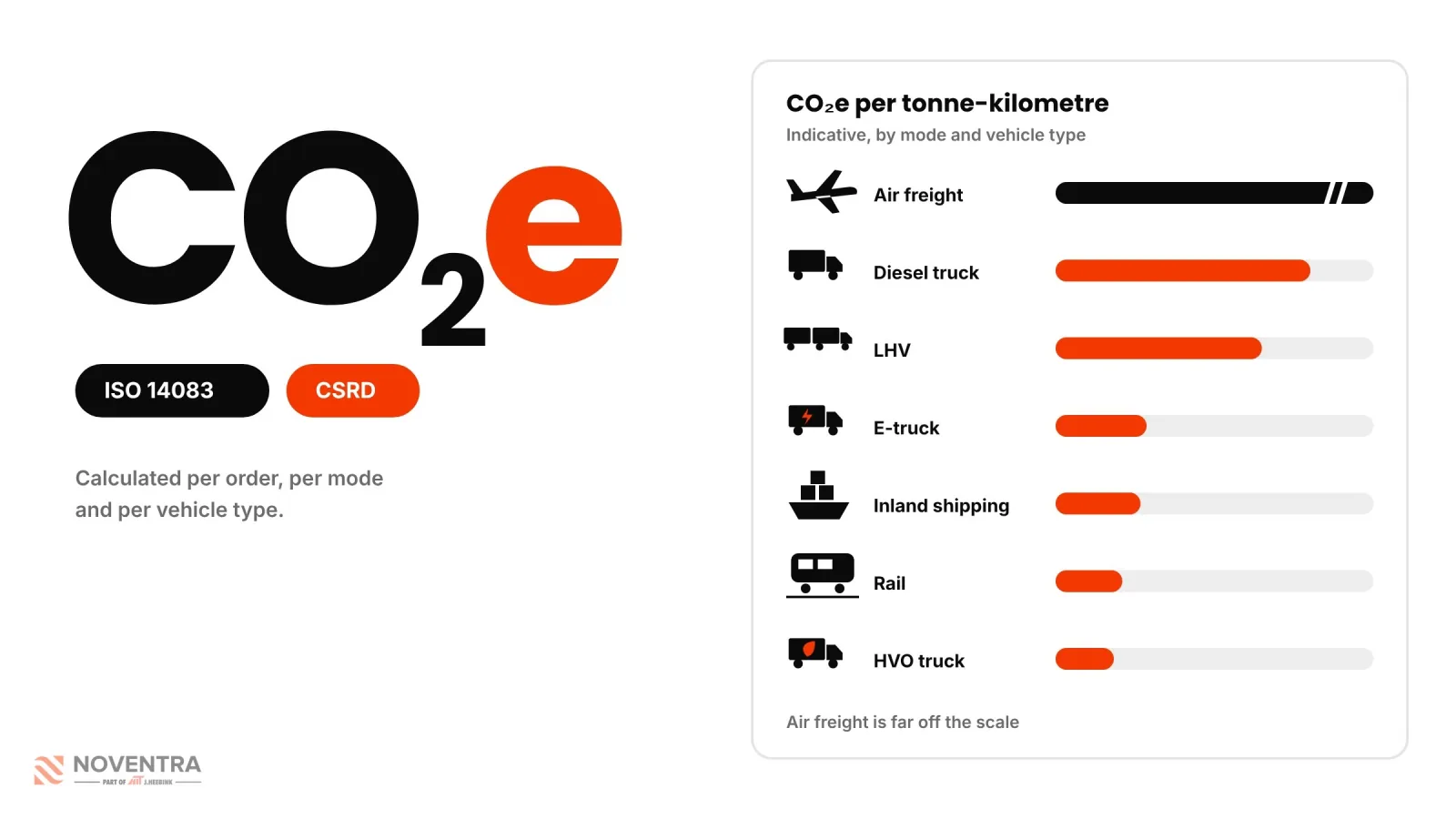
Transport emissions calculated per order, in line with the international standard.

Schematic illustration for CSRD reporting and ISO 14083

More and more organisations have to provide insight into the emissions of their transport. That applies to companies that fall under the CSRD (Corporate Sustainability Reporting Directive) themselves, but also to companies whose customers ask them to supply emissions data. Transport usually falls under Scope 3: the indirect emissions in your chain. It is often one of the hardest parts to calculate reliably. Noventra makes that calculation part of your day-to-day logistics, in line with the international standard ISO 14083.

01

When does the CSRD reporting obligation apply?

In 2026, the CSRD was simplified and finalised with the European Omnibus package. The reporting obligation applies to undertakings and groups with more than 1,000 employees and a net annual turnover of more than €450 million.

The sustainability statement is included in the annual report and reviewed by an auditor. Your transport emissions fall under Scope 3 in it. Because the report covers financial year 2027, the data must already be collected from 1 January 2027.

02

Even if you are not required to report yourself

If your organisation falls below the thresholds, you may still have to deal with the CSRD. Large customers need data on the emissions in their chain for their own report, and request it from their suppliers and logistics partners. The law does limit how much they may ask of companies with 1,000 employees or fewer. They may not demand more than the voluntary European standard prescribes. Even so, demand from the market for reliable transport emissions is already clearly noticeable.

Those who get their transport data in order now will be able to deliver it straight away, with solid backing, later on.

03

What is ISO 14083?

ISO 14083 is the international standard for calculating and reporting greenhouse gas emissions from transport and logistics activities. The standard builds on the GLEC Framework and applies to all modes: road, rail, sea, air and inland waterways, including transhipment and storage at hubs.

The core of ISO 14083 is that emissions are calculated across the whole chain, from fuel production to consumption (well-to-wheel). The emissions are fairly allocated to the shipments that were carried. Because everyone follows the same calculation method, figures are comparable and verifiable. That is essential for a report that an auditor must be able to review.

04

How Noventra calculates your transport emissions

Per order, not per year
Many organisations estimate their transport emissions afterwards, based on annual spend or total kilometres. Noventra calculates the emissions per individual order, at the moment it is submitted. This creates a detailed and up-to-date picture that you can view per customer, lane, carrier or period.

Based on real trip data
The calculation uses the actual data of the shipment: origin, destination, weight and the distance between the loading and unloading address. Where known, the carrier’s vehicle type and fuel are also taken into account.

Inbound and outbound
Because both your inbound and outbound flows run through OrangeChain, you have emissions data for both directions. That matters, because the CSRD distinguishes between upstream and downstream transport in your chain.

05

Honest about data quality

Not every carrier supplies actual consumption data today. That is why, for each calculation, we show the level on which the result is based.

So you know exactly how reliable your figures are. You can see the state of data quality per carrier, and where improvement is possible. The higher the level, the stronger your report.

06

Checks on deviating data

If incoming data deviates noticeably from what would be expected, the platform flags it automatically. Both you and the carrier involved are informed, so errors are corrected before they end up in your report.

07

Working with carriers towards better data

Better emissions data starts with the carrier. Noventra encourages carriers to move step by step towards supplying their own consumption and emissions data. Carriers also gain insight into their own figures. This way, data quality in your chain grows year after year.

08 Result

What does ISO 14083 reporting through Noventra deliver?

  • Emissions per order, instead of rough annual estimates
  • Calculated according to ISO 14083, the international standard for transport emissions
  • Transparency about data quality per calculation and per carrier
  • Verifiable figures for your CSRD report and auditor
  • Insight to become more sustainable: see where your largest emissions are and which choices make the difference, for example through Freight Management

Contact

Ready for your CSRD reporting?

Would you like to know what your transport emissions look like under ISO 14083, and how reliable your current data is? We are happy to map it out together with you.

Portrait of Mathijs van Wijnen

Mathijs van WijnenCOO / CCO

Request an emissions scan