5PL & Digital Supply Chain Integrations

Proactive disruption alerts

Know before your customer does, and adjust before things go wrong.

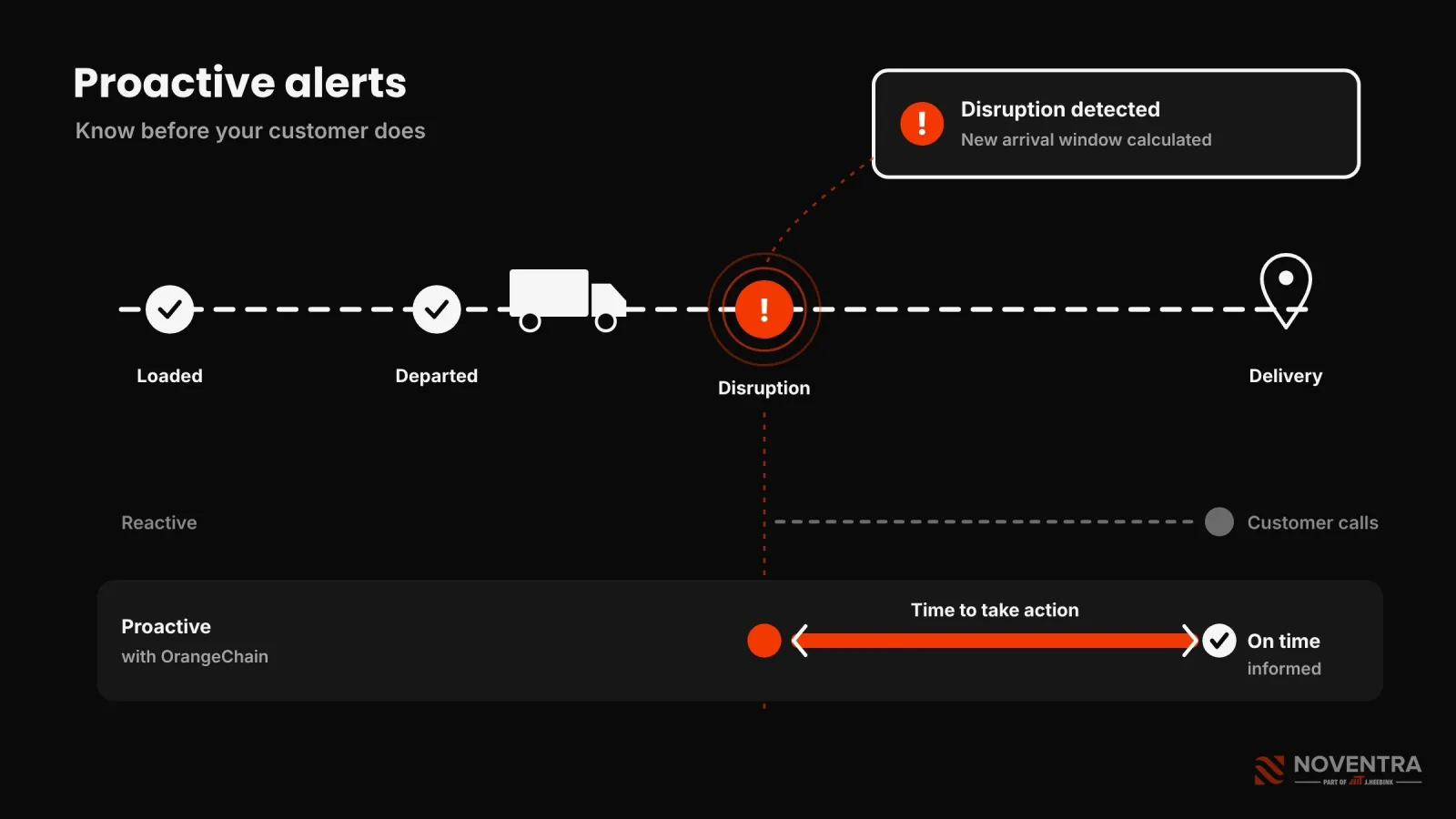
Schematic illustration of proactive disruption alerts

Disruptions in logistics are inevitable: traffic jams, breakdowns on the road, a congested loading location or a missed connection. What makes the difference is when you find out. If you only hear about it when your customer calls, all you can do is apologise. Proactive alerting, also known as supply chain monitoring or exception management, makes disruptions visible the moment they arise. At that point there is still room to intervene.

01

From reactive to forward-looking

In many transport chains, communication happens after the fact: the carrier reports a delay when the load is already late, or not at all. At Noventra, it works the other way round. Every step of the trip is recorded in OrangeChain as soon as it happens. If reality deviates from the plan, this is noticed immediately, not at the end of the day.

02

How do proactive alerts work?

Continuous visibility of progress
Carriers share progress information throughout the entire trip, from loading to delivery. If an expected update fails to arrive, that in itself is a signal.

An honest arrival window
You do not get a fixed time that later turns out to be wrong, but a realistic window that adapts to the current situation. If the window shifts, you know something is going on.

Notifications at your own pace
You decide how often and in what form you are informed about orders that need attention. One organisation wants an immediate alert, another prefers an overview per part of the day.

Clear about the impact
If a carrier reports a delay, you immediately see two things: what the consequence is and what the new expected arrival will be. That lets you decide straight away whether to inform your customer, reschedule an appointment or deploy an alternative.

03

Switching quickly in case of breakdowns

If a vehicle breaks down en route, the carrier arranges replacement equipment within a few hours. That agreement is laid down in the SLA. Through the agreed lines of communication, it is clear in each situation who needs to act, so no precious time is lost working out who should do what.

04

Learning from every disruption

One disruption is an incident; the same disruption three times is a pattern. If delays keep recurring with the same carrier, on the same route or at the same delivery address, we find the cause and tackle it. This structurally reduces the number of disruptions. Read more about this kind of insight under Data-driven logistics optimisation.

05 Result

What do proactive alerts deliver for you?

  • Time to adjust, instead of repairing afterwards
  • Better customer communication: you inform your customer before they have to ask
  • Lower failure costs from missed deliveries and rush trips
  • Calm on the work floor: no endless chasing of carriers by phone
  • Structurally fewer disruptions by tackling the cause

Contact

See disruptions coming sooner?

Would you like to know how proactive alerts work in your transport chain? We would be happy to show you in OrangeChain.

Portrait of Mathijs van Wijnen

Mathijs van WijnenCOO / CCO

Get in touch